Master Plan
Nambiar Bannerghatta Masterplan
The master plan organises 50.4 acres into a low-density villa township that backs onto the green buffer of Bannerghatta National Park. Its governing principle is restraint: with achieved residential efficiency held to about 49%, more than half the site is given over to roads, open space, landscaping and amenity infrastructure. From a planning angle, Nambiar District 25 keeps the reference local: internal roads, open-space placement, amenity access, and tower orientation all affect how the address will live after handover.
50.4
Total Acres
~49%
Resi Efficiency
12 m
Primary Roads
2 Phases
32 + 18.4 acres
Layout
The 50.4-acre layout
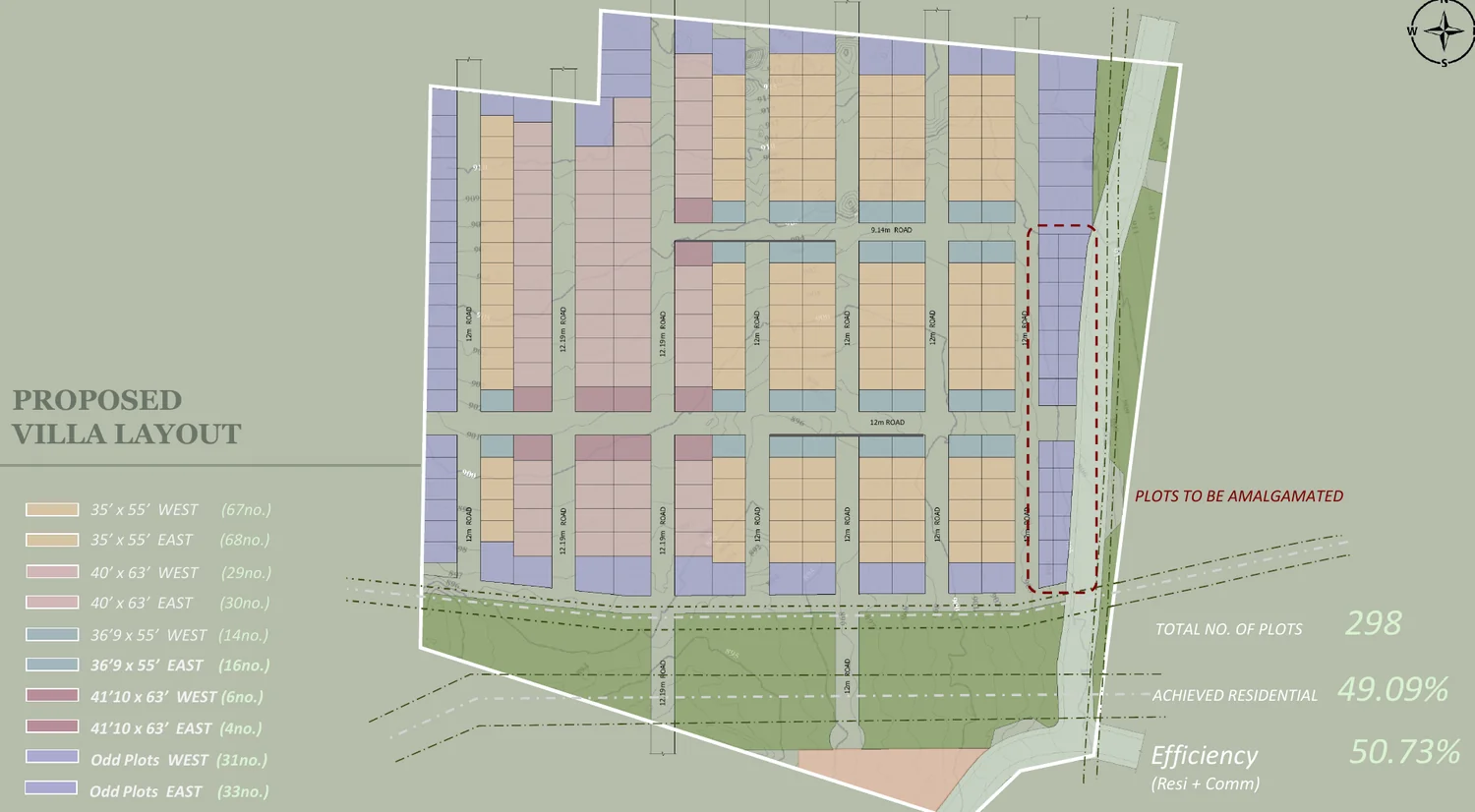
Phase 1 (32 acres, 298 villas) is laid out in clusters along 12-metre roads, with an experience centre at the northern entrance and a green amalgamation zone on the eastern edge. The southern boundary opens toward the national-park buffer, while internal greens, the clubhouse precinct and sports zones anchor the community's social life.
Land Use
How the 50.4 acres is divided
| Attribute | Specification |
|---|---|
| Total site | 50.4 acres |
| Phase 1 | 32 acres, 298 villas |
| Phase 2 | 18.4 acres (planned) |
| Achieved residential efficiency | ~49.09% |
| Overall efficiency (resi + commercial) | ~50.73% |
| Open space, roads & amenities | ~50% of site |
| Primary internal roads | 12 m |
| Secondary roads | 9.14 m |
The roughly even split between saleable plots and everything else is the master plan's headline number. In a typical plotted development, efficiency runs much higher, packing in plots at the expense of commons. Nambiar Bannerghatta deliberately inverts that, trading saleable area for the wider streets, deeper setbacks, central greens and amenity land that define a genuine villa community.
Villa Placement
Clusters, orientation and privacy
Within Phase 1, the 298 villas are arranged in clusters along a grid of internal roads. The four villa footprints - 35'x55' (135 villas), 36'9"x55' (30), 40'x63' (59) and 41'10"x63' (10), plus a set of odd plots (64) - are distributed across the grid in both east- and west-facing orientations, so buyers can choose plot size and orientation together. Clustering villas of similar format keeps the streetscape coherent while the three facade themes add variety from street to street.
Low density is engineered through the geometry. With achieved residential efficiency at about 49%, plots carry deeper setbacks and the streets carry wider verges than a typical plotted layout would allow. The 40'x63' villa, for instance, is planned with a front yard of roughly 5.5 metres and a private backyard of about 4.3 metres, so each home sits within its own garden envelope rather than abutting the plot boundary. Combined with the clustering strategy and the canopy planting along the 12-metre roads, this delivers genuine privacy between homes.
Open Space & Infrastructure
A green-belt network and underground servicing
Open space is the master plan's organising element rather than an afterthought. The southern boundary opens toward the national-park buffer, borrowing that protected greenery as the community's backdrop. Internally, central greens, landscaped pockets between clusters, and the amenity precinct around the clubhouse stitch the village together with planting, threaded by jogging and cycling trails, walking loops and a reflexology walk that connect homes to the clubhouse and play areas without forcing residents onto the vehicle roads.
A premium villa community lives or dies on the infrastructure that residents never see. Power is distributed underground from 400 KVA and 66 KVA HT lines on site, keeping the streetscape free of overhead cabling. Water supply, sewerage and stormwater drainage run below ground along the road network. An on-site STP treats all wastewater with treated water reused for landscape irrigation and flushing, while rainwater-harvesting structures recharge groundwater and prevent run-off into the adjacent national-park buffer.
Reading the Plan
How the master plan serves buyers
For a buyer, the master plan answers the questions that matter most about a villa community. Will it feel spacious? The ~49% efficiency and 12-metre roads say yes. Will the green setting last? The southern edge opens onto a protected park buffer, so yes. Will the amenities be ready when I move in? Phasing concentrates the launch villas, clubhouse and infrastructure in Phase 1, so the first residents inherit a working community rather than a construction site. And will the infrastructure hold up? The underground utilities, on-site STP and rainwater harvesting are engineered for the full 298-home load.
Taken together, the Nambiar Bannerghatta master plan reads as a coherent, deliberate blueprint rather than a maximised subdivision - which is exactly what a villa buyer is paying for. See the floor plans for how the individual villas sit on their plots, and the amenities page for the distributed amenity network.
Request the master plan
Our team can share the detailed master plan, villa positions and the phasing schedule on request. Use the contact page to start the conversation.
Land Use & Phasing Detail
Nambiar Bannerghatta land-use philosophy
The Nambiar Bannerghatta master plan organises 50.4 acres into a calibrated mix of saleable plots and supporting infrastructure. Achieved residential efficiency is held to about 49.09% — overall efficiency including the small commercial provision rises to roughly 50.73% — which means more than half the site is given over to roads, open space, landscaping and amenity infrastructure rather than saleable area. In a typical plotted layout, efficiency runs far higher, packing in plots at the expense of commons. Nambiar Bannerghatta deliberately inverts that, trading saleable area for the wider streets, deeper setbacks, central greens and amenity land that define a genuine villa community.
The two-phase structure matters for both delivery and lived experience. Phase 1 occupies the northern 32 acres and carries all 298 launch villas, the experience centre at the northern entrance, and the first tranche of amenities and below-ground infrastructure — the clubhouse, the pool, the central greens, the STP and the underground utility network are all engineered for the full Phase 1 load. Phase 2 adds 18.4 acres to the south and will be developed subsequently. Phasing lets the developer match construction to sales, fund infrastructure progressively, and deliver the first homes — and a working clubhouse and greens — without waiting for the entire 50.4 acres to complete. An eastern strip is marked for plot amalgamation, giving the layout flexibility to combine units where the topography or demand calls for larger holdings.
Green Belt & Sustainability
Nambiar Bannerghatta green belt and sustainability infrastructure
The southern boundary opens toward the green buffer of Bannerghatta National Park, borrowing that protected greenery as the community's permanent backdrop. Internally, central greens, landscaped pockets between clusters, and the amenity precinct around the clubhouse stitch the village together with planting. The "Nature / Eco" concept extends into the landscape: native and canopy trees, natural-stone retaining walls and textured ground treatments carry the material language of the villas out into the commons, so built form and landscape read as one rather than as two competing palettes. Gathering lawns, an amphitheatre and senior-citizen seating courts give the open space programmed social anchors, while pet-friendly green pockets and children's play areas distribute family-scale amenities across the layout rather than concentrating them in one corner.
The sustainability infrastructure matches the forest-edge positioning. An on-site sewage treatment plant treats all wastewater for the 298-home community, with treated water reused for landscape irrigation and flushing — significantly reducing fresh-water demand. Rainwater harvesting structures and a managed stormwater network capture rainfall, recharge groundwater and prevent run-off into the adjacent national-park buffer. The ~49% residential efficiency preserves permeable ground and tree cover across the site. Provisions for solar common-area lighting reduce the community's grid draw, while EV-charging provisions are designed into the infrastructure for the long-term electrification of household mobility. Together these measures make Nambiar Bannerghatta a community designed to sit lightly on its forest-edge site over decades, not just at handover.
Topography & Water
Working with the land's contours
The aerial site plan shows gently varied terrain, and the Nambiar Bannerghatta master plan works with the land's natural contours rather than flattening them wholesale. Natural-stone retaining walls — a recurring element in the project's material palette — manage the level changes between plots and roads, turning grading into an architectural feature rather than an engineering scar. Working with the topography reduces earthwork, preserves existing trees and natural water flow, and gives the streetscape subtle variation in level that adds character to the layout. For buyers, the practical benefit is villas that sit comfortably on their plots with proper drainage and mature landscaping, rather than homes perched on heavily engineered platforms.
The site's western and southern edges carry natural drainage — including a nala (storm-drain) channel — and the master plan treats this as a design opportunity rather than a constraint. Maintaining a buffer along the drainage line protects the villas from flooding, preserves natural water movement across the site, and adds another band of green to the community's edge. Combined with the rainwater-harvesting network and the managed stormwater drains along the internal roads, this water-sensitive planning ensures that the 50.4-acre site sheds and recharges rainfall without overwhelming either its own infrastructure or the adjacent national-park buffer downstream. It is the kind of below-the-surface engineering that distinguishes a well-planned township from a simple plotted layout.
Orientation Planning
Solar planning, setbacks and the experience centre
The master plan's grid is deliberately set out to give every villa a clear east- or west-facing orientation rather than leaving aspect to chance. This matters in Bengaluru's climate: east-facing villas draw morning light into their living spaces, while west-facing villas capture evening sun, and the consistent plot depths allow each home to be planned around its aspect. The villa floor plans reinforce this — living areas are placed in the northern zone of each plot, with kitchens and master suites oriented to optimise light and cross-ventilation. The result is a layout where the relationship between sun, plot and floor plan has been resolved at the master-planning stage, not left to the individual home.
The northern edge of Phase 1 carries the experience centre — the first built expression of the community and the point at which prospective buyers encounter the design language. Positioned at the controlled entrance, it anchors the arrival precinct: the security gate, the visitor drop-off and the first stretch of 12-metre internal road. Locating the experience centre here lets the developer present the master plan, the villa formats and the material palette on site, against the backdrop of the forest-edge setting, while the rest of Phase 1 is built out. Over time, the entrance precinct becomes the community's front door — the threshold between the arterial approach and the calm of the internal streets. For a buyer evaluating the master plan, a visit to the experience centre is the single most useful way to read its intent before committing.
Master Plan Questions
Nambiar Bannerghatta Master Plan - FAQ
What does the Nambiar Bannerghatta master plan show?
A 50.4-acre, two-phase villa township: Phase 1 of 32 acres with 298 G+2 villas in clusters along 12-metre roads, an experience centre at the northern entrance, a central clubhouse and amenity precinct, and a southern boundary opening onto the national-park buffer.
How is the land divided?
With achieved residential efficiency at about 49% (overall ~50.73%), roughly half the site is given over to roads, open space, landscaping and amenity infrastructure rather than saleable plots - the headline number that makes the community genuinely low-density.
How are the villas arranged?
Within Phase 1, the 298 villas are arranged in clusters along a grid of internal roads. The four footprints are distributed across the grid in both east- and west-facing orientations, with the three facade themes - Serene, Mellow and Halcyon - adding variety from street to street.
What are the road widths?
Primary internal roads are 12 metres wide, with 9.14-metre secondary roads serving the inner clusters. The hierarchy keeps through-traffic on the main loops and calms movement within the residential clusters, so the streets function as shared, walkable space.
What sustainability infrastructure does the master plan include?
An on-site sewage treatment plant with treated-water reuse, rainwater harvesting and a managed stormwater network, underground utilities from 400 KVA and 66 KVA HT lines, and provisions for solar common-area lighting and EV charging.
How is the project phased?
Phase 1 occupies the northern 32 acres and carries all 298 launch villas plus the experience centre and the first tranche of amenities and infrastructure. Phase 2 adds 18.4 acres to the south and will be developed subsequently.